True Winter vs. Deep Winter: How to Tell the Difference
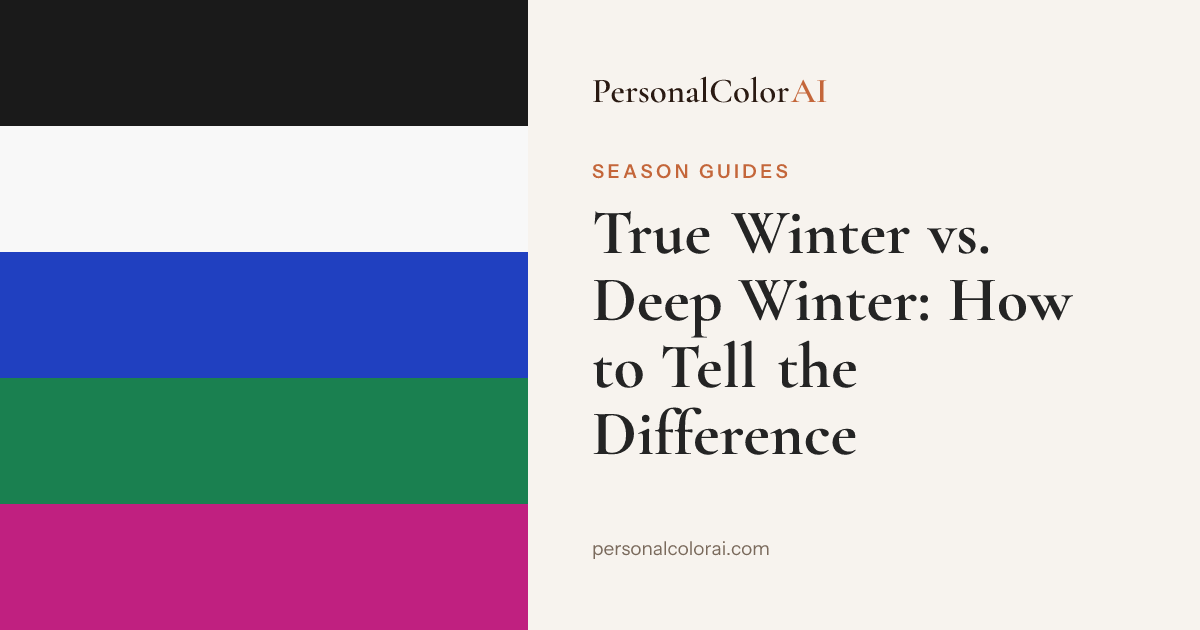
True Winter and Deep Winter are both cool, deep, and high-contrast, so they differ mainly on chroma and warmth. True Winter is the clearer, more saturated cool palette — royal blue, true red, ice pink, emerald. Deep Winter is the deepest, richest end with a cool-neutral edge — burgundy, deep plum, charcoal. The tell: ice blue flatters True Winter most; burgundy flatters Deep Winter most. Both wear black beautifully.
Both cool and deep — so which Winter are you?
This is the closest of the Winter pairings, because True Winter and Deep Winter share three of the four coloring axes: both are cool, both are deep, and both are high-contrast. Their palettes overlap more than almost any other pair in the twelve-season system, and if you have tested as one but keep suspecting the other, that instinct is well-founded — the boundary between True Winter and Deep Winter is one of the most common places to sit. What separates them is not warm versus cool, since both are cool. It is chroma and the exact quality of depth: True Winter runs clearer and icier, Deep Winter runs darker and richer with a faint warm-neutral undertow.
| True Winter Palette | |||||
|---|---|---|---|---|---|
| #1A1A1A | #F8F8F8 | #2040C0 | #1A8050 | #C02080 | #680828 |
| Deep Winter Palette | |||||
|---|---|---|---|---|---|
| #282828 | #0A1028 | #380848 | #480818 | #0A2818 | #0A0A0A |
The core difference: chroma and depth
True Winter is the clearest, most saturated cool palette in the system. Every neutral and every accent is decisively cool and turned up to full clarity — true black and bright white are its power neutrals, crisp and uncompromising, and its brights read like stained glass. Deep Winter sits at the deepest end of Winter and bridges very slightly toward Autumn. Its neutrals are darker and a touch warmer — deep plum and dark burgundy sit where True Winter would use icy grey — and it is cool-neutral rather than purely cool. Where True Winter demands icy precision, Deep Winter demands rich, enveloping darkness. The saturation dial is the clue: True Winter wants maximum clarity, Deep Winter wants maximum depth.
Three tests to settle it
The jewelry test barely moves here since silver flatters both, but there is a nuance: True Winter cannot carry any warmth at all — even rose gold feels slightly off — while Deep Winter can occasionally handle a dark, warm-toned metal in small doses. Second, the color test: hold royal blue (#2040C0) to your face, then deep plum (#380848). Royal blue is True Winter's signature and should make your skin snap into clarity; deep plum is Deep Winter's home and should feel like a natural extension of your coloring. Third, the neutral test: true black plus bright white versus dark charcoal plus deep plum. True Winter thrives in that stark high-contrast pairing; Deep Winter looks more grounded in the deeper, slightly less stark combination.
Find your color season — free analysis
Who each season flatters
True Winter flatters people with purely cool, high-contrast coloring and sharp, defined features — the ones stark cool colors make glow rather than overwhelm, like Jisoo of BLACKPINK or Kim Kardashian. Deep Winter flatters people with commanding deep coloring and a cool-neutral undertone, for whom plum and dark navy read as rich rather than heavy — think Song Hye-kyo or Angelina Jolie. Both build a wardrobe around a strong cool dark neutral, so the split comes down to whether you want the icy-clear version or the deep-rich version. The full hex-coded sets live on the True Winter best colors and Deep Winter best colors pages, and both seasons can share black as a common power neutral.
Common misreads to watch for
The clearest evidence comes from watching the wrong palette in action. A True Winter in Deep Winter's deep plum and dark burgundy looks slightly muddied — the faint warmth in those tones creates a subtle disconnect with purely cool coloring, and the crispness that defines True Winter softens in a way that reads as off rather than rich. A Deep Winter in True Winter's stark black-and-white contrast can look slightly harsh — the icy precision overwhelms the richness, when Deep Winter wants depth and darkness rather than brightness. The common trap is assuming that because both wear black, the whole palette transfers; it does not. If you are sitting on this border, a free AI analysis returns a confidence score and secondary season so you know exactly where on the Winter spectrum you fall.
Frequently Asked Questions
What's the difference between True Winter and Deep Winter?
True Winter is purely cool and maximally saturated — its power neutrals are true black and bright white. Deep Winter is cool-neutral and even deeper, sitting at the Winter-Autumn boundary. Deep Winter can carry slightly warmer dark tones like deep plum and dark burgundy that True Winter cannot wear without looking slightly off.
How do I tell if I'm True Winter or Deep Winter?
Hold royal blue to your face, then deep plum. Royal blue snapping your skin into clarity points to True Winter; deep plum feeling like a natural extension points to Deep Winter. Also check whether you look best in stark black-and-white contrast or in deep, rich cool-neutral tones like charcoal and plum.
Can you be between True Winter and Deep Winter?
Yes — it is a common in-between position. If your confidence score is below about 75% for either season, both palettes are worth exploring. The deciding test is whether pure cool black-and-white contrast or deep rich cool-neutral tones flatter you more.
Do both seasons wear black well?
Yes. Black is a shared power neutral for both True Winter and Deep Winter, which is part of why they are so easy to confuse. The difference shows up in the accents — icy clear brights for True Winter, deep enveloping darks for Deep Winter — rather than in the black itself.
Which is more common — True Winter or Deep Winter?
True Winter is generally considered more common. Deep Winter requires both very deep coloring and a cool-neutral rather than purely cool undertone, which is a more specific combination and therefore less frequent.