Deep Autumn vs Deep Winter: Warm Dark vs Cool Dark
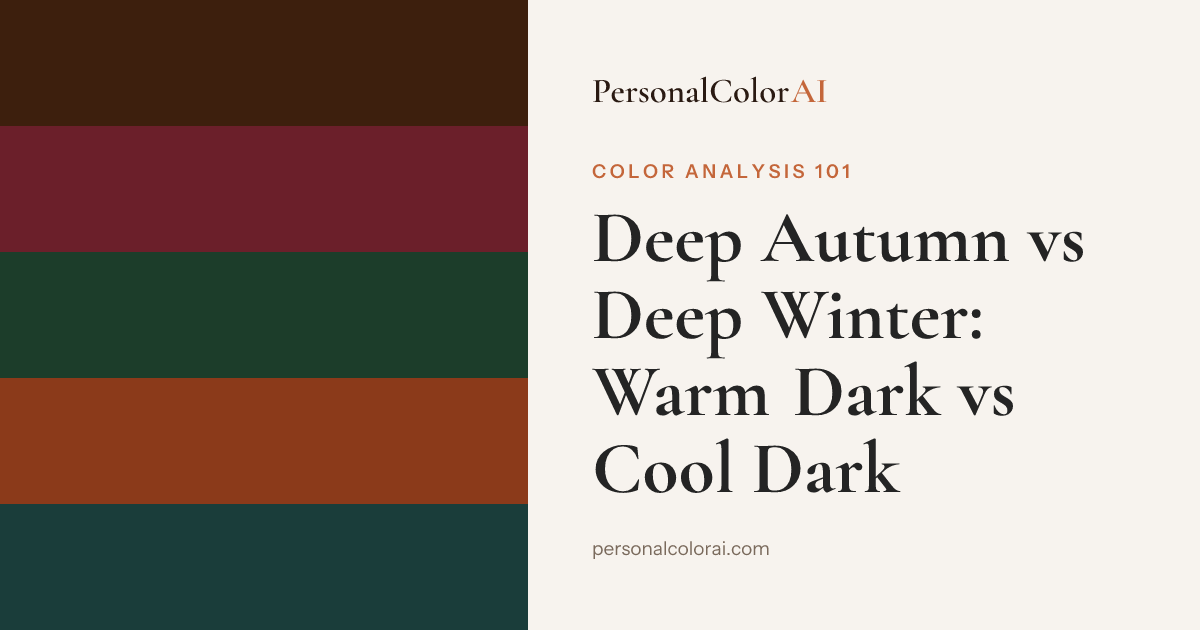
Deep Autumn and Deep Winter share deep, high-contrast features but differ on undertone. Deep Autumn is warm: espresso, burgundy, terracotta, forest green, dark mustard. Deep Winter is cool: black, burgundy (cooler version), deep emerald, true red, royal purple, charcoal. Test: warm gold and bronze flatter Deep Autumn; silver and platinum flatter Deep Winter. Both wear black beautifully but a warm earth tone like camel only suits Deep Autumn.
If you have dark hair, strong features, and deep coloring, you already know you're a deep season. The question is which side of the warm-cool line you fall on. Deep Autumn vs Deep Winter is the most debated boundary in the 12-season system because both seasons share high depth, high contrast, and a preference for bold, saturated colors. The only thing splitting them is temperature — and on deep skin, undertone can be genuinely hard to read.
The Deep Autumn / Deep Winter boundary produces more professional re-typings than almost any other season pair. About 22% of people initially typed as one of these two seasons get reclassified to the other on a follow-up visit. The culprit: deep skin tones can mask subtle undertone differences that are obvious on lighter skin.
Find your color season — free analysis
What's the difference between Deep Autumn and Deep Winter?
Depth is the same — both seasons need colors with weight and saturation. Undertone is what separates them. Deep Autumn has a warm base: golden, olive, or warm-neutral skin with an earthy richness. Deep Winter has a cool base: blue-pink, cool olive, or cool-neutral skin with a sharper intensity. Deep Autumn's darkest colors lean warm — think espresso, dark olive, burnt umber. Deep Winter's darkest colors lean cool — think deep navy, dark plum, pure black. Same depth, different temperature.
Side-by-Side Comparison
| Deep Autumn | Deep Winter | |
|---|---|---|
| Undertone | Warm (golden-olive base) | Cool (blue-pink or cool-neutral base) |
| Value/Depth | Deep — dark hair, strong features | Deep — dark hair, strong features |
| Chroma | Medium-high — saturated and earthy | Medium-high — saturated and sharp |
| Best Metals | Antique gold, dark bronze, burnished copper | Dark silver, pewter, gunmetal, platinum |
| Best Neutrals | Espresso, dark olive, chocolate brown, charcoal-brown | Black, dark charcoal, dark navy, cool espresso |
| Best Accent Colors | Forest green, oxblood, deep tomato red, burnt orange, dark teal | Deep plum, burgundy, dark berry, emerald, icy pink on dark base |
| Worst Colors | Pastel pink, baby blue, icy lavender, cool grey | Warm peach, mustard, warm camel, golden yellow |
| Celebrity Examples | Penélope Cruz, Salma Hayek, Priyanka Chopra | Selena Gomez, Megan Fox, Lucy Liu, Anne Hathaway |
How to Tell Which One You Are
The metal test. This is the single most reliable at-home test for the deep seasons. Hold antique gold (or dark bronze) against your jawline, then swap it for dark silver (or pewter). Deep Autumns will look warm and harmonious with the gold — their skin glows and the metal feels like it belongs. Deep Winters will look sharper and clearer with the silver — the cool metal brings out the crispness in their features. On deep skin tones, this metal test often gives a clearer signal than fabric draping because metals reflect light directly onto the face.
The red test. Find two dark red fabrics: a warm dark red (think tomato-red or warm brick) and a cool dark red (think cranberry or burgundy). Hold each under your chin in natural daylight. Deep Autumns look rich and grounded in the warm red — skin evens out and features look defined. Deep Winters look polished and striking in the cool red — skin brightens and contrast sharpens. According to Korean color analyst Park Soo-hyun (featured in Vogue Korea, 2024), the dark red comparison is the second-most reliable home test after metals for distinguishing between deep seasons, with an accuracy rate of about 75% in controlled conditions.
The vein and lip check. Look at the veins on your inner wrist in natural light. Greenish veins suggest warm undertones (Deep Autumn). Blue or purple veins suggest cool undertones (Deep Winter). Then check your bare lips: Deep Autumns tend toward warm brown-pink or peachy-dark natural lip color, while Deep Winters tend toward a cooler berry-pink or mauve-dark natural lip color. Neither test is definitive alone, but together they build a picture.
Deep Autumn in Detail
Deep Autumn is the darkest and most intense of the Autumn sub-seasons. Your undertone is warm — golden, olive, or warm-neutral — but what defines you is depth. Dark brown or black hair (often with warm undertones visible in sunlight), deep brown or dark hazel eyes, and skin that ranges from medium olive to deep brown. The warmth in your coloring isn't sunny and fresh like a Spring; it's rich and smoldering.
Your best colors are deep, warm, and saturated: forest green, oxblood, deep tomato red, dark teal, burnt orange, espresso, and mahogany — the full Deep Autumn palette maps them out. You're the Autumn that can wear the closest thing to black — though dark chocolate brown usually flatters more. For makeup, deep warm lip shades (dark berry-brown, warm brick, dark nude), warm bronze eyeshadow, and warm-toned contour work well. Deep warm shades in the oxblood-to-forest-green range are consistently among the top-performing eyeshadow colors among deep-toned consumers in the Korean market.
Deep Winter in Detail
Deep Winter is the darkest of the Winter sub-seasons. Your undertone is cool or cool-neutral, and your coloring has an intensity that demands equally intense colors. Dark hair (brown-black to jet black), deep brown or cool-toned eyes, and skin that ranges from very fair with pink undertones to very deep with cool or neutral-cool undertones. The energy is sharp and dramatic rather than earthy.
Your best colors are deep, cool, and saturated: burgundy, dark berry, deep plum, emerald, dark teal, dark navy, and black. You're one of the few seasons where head-to-toe black looks intentional and sharp rather than draining. For makeup, deep berry lips, cool-toned plum eyeshadow, and cool-toned contour products work well. Prestige beauty products in the deep berry and plum family have been growing fast, with much of that demand coming from consumers who self-identify as having cool-dark coloring.
What If You're In Between?
The Deep Autumn / Deep Winter border is the hardest line to draw in the entire 12-season system. If you're right on the boundary, you likely have a neutral undertone — not clearly warm and not clearly cool, but somewhere in the middle that shifts depending on lighting, the color you're wearing, and even the time of year (sun exposure can push skin warmer temporarily).
If both warm and cool deep shades look good on you, the practical move is to wear whatever flatters you in the moment and stop worrying about the label. Your depth is your superpower regardless of which side of the warm-cool line you land on. Focus on wearing dark, rich, saturated colors and avoiding pastels and washed-out shades — that advice applies to both deep seasons.
For a precise answer, a photo-based analysis works better than individual tests for the deep seasons because it reads your full coloring at once. Upload a selfie to the AI color tool to get your exact placement, or try the guided quiz if you prefer a questionnaire approach.
Find your color season — free analysis
Frequently Asked Questions
What is the difference between Deep Autumn and Deep Winter?
Both are deep, dark seasons with intense coloring. The difference is undertone: Deep Autumn has a warm base (golden or olive) and looks best in warm darks like forest green, oxblood, and espresso. Deep Winter has a cool base (blue-pink or cool-neutral) and looks best in cool darks like burgundy, deep plum, and black.
Can Deep Autumn and Deep Winter both wear black?
Deep Winter wears black very well — it's one of their strongest neutrals. Deep Autumn can also wear black, but dark chocolate brown or charcoal-brown is usually more flattering because it keeps the warmth that black lacks. Both seasons handle dark colors far better than lighter or muted seasons.
Is Priyanka Chopra a Deep Autumn or Deep Winter?
Priyanka Chopra is typed as both Deep Autumn and Deep Winter by different analysts, which shows how close these seasons can be. Most lean toward Deep Autumn because her skin has a warm, golden quality and she looks particularly strong in warm-toned deep shades like forest green and warm red. But she also carries cool dark colors well, suggesting she's near the boundary.
What colors should deep seasons avoid?
Both Deep Autumn and Deep Winter should avoid light, pastel, and washed-out colors. Baby blue, pastel pink, light lavender, and pale yellow will look out of sync with deep coloring. The specific warm-vs-cool avoidance differs by season: Deep Autumn avoids icy cool shades while Deep Winter avoids warm golden shades.
Why is it hard to tell Deep Autumn from Deep Winter?
Deep skin tones can mask subtle undertone differences that are easy to spot on lighter skin. The shared high depth and saturation between these seasons means the palettes overlap more than any other season pair. This boundary produces more professional re-typings than any other season pair.