True Spring vs. True Summer: Warm Freshness vs. Cool Softness
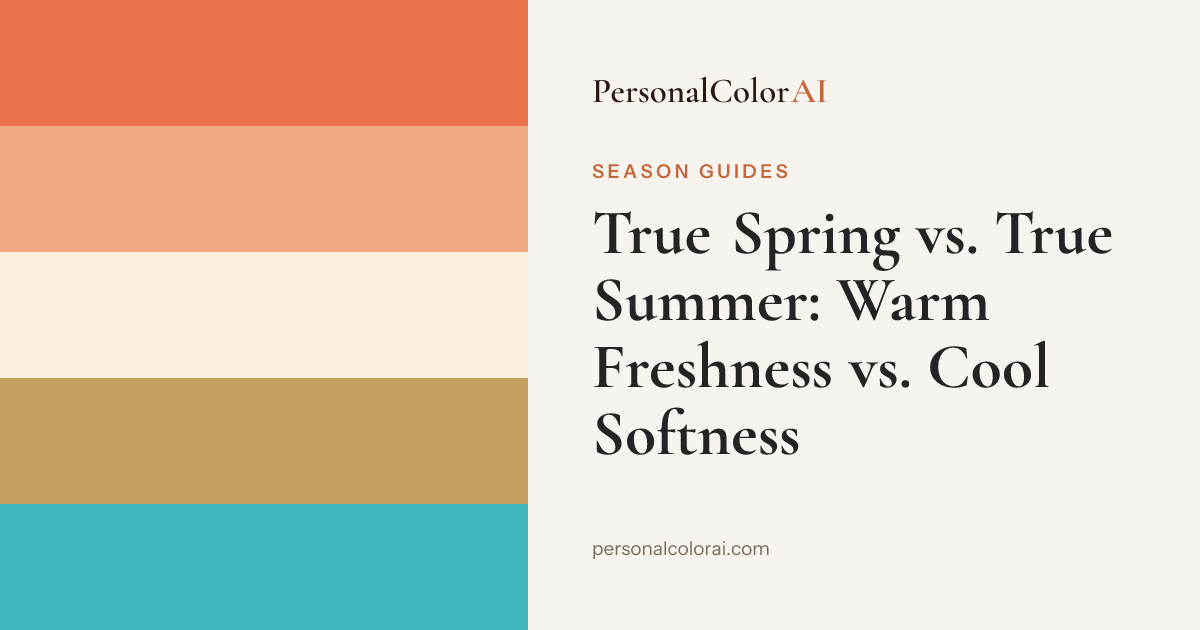
True Spring and True Summer are both balanced, medium-depth seasons, but True Spring is warm and clear while True Summer is cool and soft. True Spring glows in coral, warm peach, light turquoise, and golden yellow. True Summer flatters dusty rose, periwinkle, sage, and soft plum. The fastest tell: warm gold jewelry flatters True Spring, while silver and rose gold flatter True Summer. That single warmth direction predicts everything else.
What's the difference between True Spring and True Summer?
Both are medium depth, both medium contrast, and both sit near the balanced center of the system — which is exactly why people land between them. The deciding factor is undertone. True Spring is warm and clear: its colors look like they were mixed with sunlight, so coral, warm peach, and light turquoise glow against golden skin. True Summer is cool and soft: its colors look like they were mixed with a drop of grey, so dusty rose, periwinkle, and soft plum harmonize with rosy, cool-toned skin. Same balance, opposite temperature — that is the whole comparison in one sentence. If you want the deeper palette breakdowns, the True Spring color guide and the True Summer color guide show the full spectrum each one carries.
| True Spring Palette | |||||
|---|---|---|---|---|---|
| #E8734A | #F0A882 | #FBF0E0 | #C4A060 | #40B8C0 | #F0C840 |
| True Summer Palette | |||||
|---|---|---|---|---|---|
| #E8A0B0 | #C0A8D8 | #8098B8 | #C098A8 | #A06080 | #A0B8D0 |
The deciding cue: warmth, not depth
With most comparison pairs you weigh several factors, but here depth and contrast are essentially tied, so you can ignore them and go straight to temperature. The single most useful fabric test for this boundary is coral (#E8734A) versus rose pink (#E8A0B0). Hold each against bare skin in natural daylight, no makeup, no colored top nearby. One will make your complexion look fresher, clearer, and more lit-from-within; the other will leave a faint shadow or a slightly muddy cast under the jaw. That winner is your season. Coral pulling you forward means warm, so True Spring. Rose pink evening out your skin means cool, so True Summer. The jewelry test agrees almost every time: gold for Spring, silver or rose gold for Summer.
Which one am I? A quick decision heuristic
Run three checks and take the majority. First, jewelry: does warm gold light your face up, or does it look brassy next to silver? Second, the coral-versus-rose fabric test above. Third, denim: a warm, golden-wash denim tends to suit True Spring, while a cool, blue-grey wash suits True Summer. If all three lean the same way you have a confident answer. If they split, you are genuinely close to the border, and the safest move is to start from each season's clearest signature color and see which family your eye keeps returning to. When you cannot call it by eye, a free AI analysis reads undertone, depth, and contrast from one selfie and gives you a confidence score.
Find your color season — free analysis
What each season flatters, and common misreads
True Spring flatters warm, clear colors: coral, warm peach, golden yellow, and light turquoise, with warm ivory and camel as neutrals. IU and Blake Lively are frequently cited examples — their golden, clear coloring comes alive in exactly those shades. True Summer flatters cool, softened colors: dusty rose, periwinkle, sage, and soft plum, with slate grey and soft navy as neutrals. Rosé of BLACKPINK and Natalie Portman read as classic cool-soft coloring. The most common misread runs in one direction: a True Summer gets pushed toward Spring because they tan easily and assume warmth, when the tan is surface color rather than undertone. The reverse misread — a warm True Spring mistaking themselves for cool — usually traces back to testing under yellow indoor light, which flatters warmth artificially and hides the true read.
The shared middle ground
Both palettes carry medium-depth teal and aqua, which is why some people feel both partly work. That overlap is real but narrow. The divergence happens at the extremes: a True Spring in True Summer's lavender and dusty blue looks slightly drained, the cool mutes pulling warmth out of the skin. A True Summer in True Spring's coral and warm peach looks slightly sallow, the warmth casting a yellowish tint on cool skin. The middle overlaps; the signature colors decide.
Find your season
Still on the fence between warm-fresh and cool-soft? Upload a selfie and our free AI analysis places you in one of the twelve seasons in about a minute, then hands you the exact palette to shop from.
Frequently Asked Questions
What's the difference between True Spring and True Summer?
True Spring is warm-undertoned with clear, fresh coloring — coral, peach, warm turquoise, and camel are its signatures. True Summer is cool-undertoned with soft, romantic coloring — dusty rose, lavender, dusty blue, and soft mauve are its signatures. Both have medium depth and contrast but diverge completely on undertone.
How do I know if I'm True Spring or True Summer?
The most reliable single test: hold coral fabric (#E8734A) against your face, then rose pink (#E8A0B0), in natural light. Whichever makes your skin look clearer, fresher, and more alive is your season. The jewelry test agrees — gold for True Spring, silver or rose gold for True Summer.
What traits do True Spring and True Summer share?
Both are medium depth, medium contrast, and balanced — the two most 'average' seasons in the system, with no extreme lightness, darkness, or vividness. They also share a band of medium teal and aqua that partly flatters both, which is a big reason the pair gets confused.
Can True Spring wear cool colors?
True Spring can wear clear, warm-leaning cool accents like turquoise and aqua that still carry warmth. It cannot wear the softer, greyed cool tones of True Summer — dusty blue and lavender — without looking slightly washed out.
Why do people mix up True Spring and True Summer?
Because depth and contrast are nearly identical, so the only real difference is undertone. A True Summer who tans easily often assumes they're warm, and anyone testing under yellow indoor light will read warmer than they are. Judging temperature in neutral daylight settles it.