Soft Summer vs True Summer: How to Tell the Difference
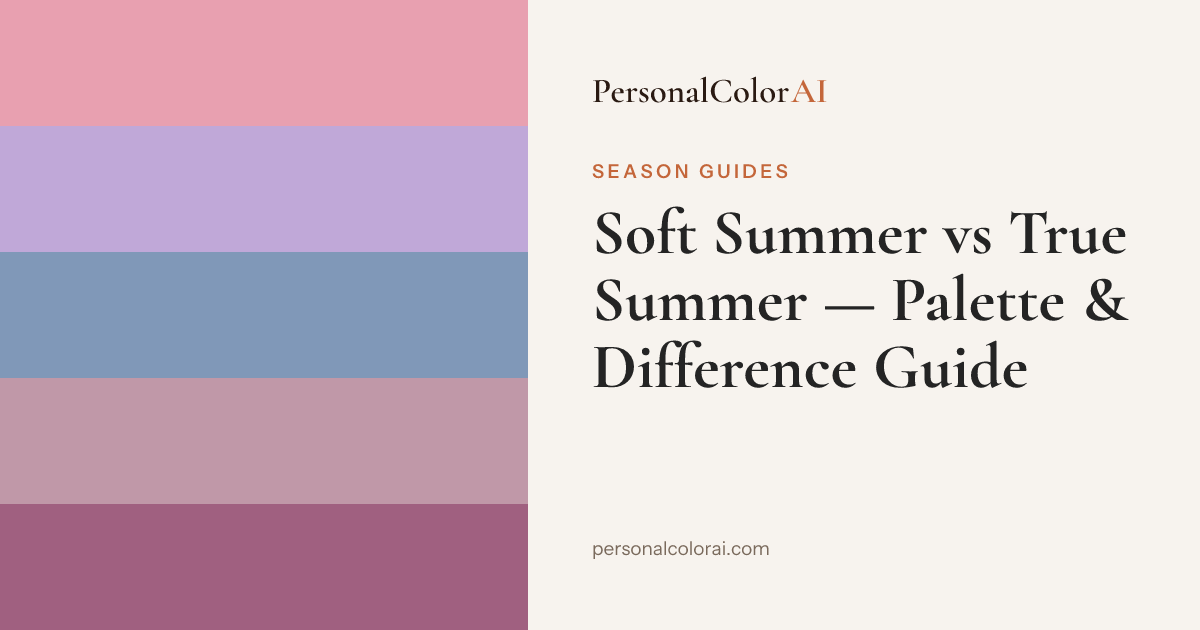
Soft Summer and True Summer share cool-neutral undertones and medium depth, but Soft Summer is more muted while True Summer is balanced cool. Soft Summer signature colors: taupe, sage, soft plum, muted blue, cocoa rose, cool gray. True Summer signature: dusty rose, periwinkle, sage, soft plum, powder blue. Test: True Summer can wear bolder shades like teal and soft burgundy; Soft Summer needs everything dustier and softer to match its low-contrast natural coloring.
Why these two get confused
Soft Summer and True Summer are both cool, both soft, both low-contrast and romantic. They share the gentlest palettes in the system — dusty roses, muted blues, grayed lavenders — and their overall aesthetic is so similar that sitting between them is one of the most common results in Korean color analysis.
Soft Summer vs True Summer at a glance
The two seasons split on three things color analysts measure: undertone, value (how light or deep the coloring is), and chroma (how muted or clear it is). Here is how they compare.
| Trait | Soft Summer | True Summer |
|---|---|---|
| Undertone | Cool-neutral, leans muted | Cool, balanced |
| Value (depth) | Medium, soft | Medium |
| Chroma (saturation) | Low — everything grayed | Low-medium — slightly clearer |
| Contrast | Very low, blended | Low to medium |
| Best metals | Silver, sometimes rose gold | Silver only |
| Signature colors | Taupe, sage, soft plum, cocoa rose | Dusty rose, periwinkle, powder blue |
| Soft Summer Palette | |||||
|---|---|---|---|---|---|
| #D09898 | #A898B8 | #608888 | #8898A8 | #A88090 | #909880 |
| True Summer Palette | |||||
|---|---|---|---|---|---|
| #E8A0B0 | #C0A8D8 | #8098B8 | #C098A8 | #A06080 | #A0B8D0 |
What is the core difference between True Summer and Soft Summer?
Soft Summer is the more muted and neutral-cool of the two, sitting at the Summer-Autumn boundary. Its colors are grayer, more diffused, and more understated. Dusty rose, grayed lavender, and muted teal suit it better than anything with real clarity. See the full Soft Summer palette for the range.
True Summer has slightly more depth and saturation. Its cool tones are cleaner and more defined — rose pink, lavender, and dusty blue have a soft clarity to them. True Summer is cool, period. The complete True Summer palette shows how much clearer its colors run.
Soft Summer coloring in detail
Soft Summer skin has a cool-neutral base — a blue-grey or soft rose-grey cast rather than a clear pink — and the overall effect is gentle and blended. Hair is usually ash brown, mousy brown, or soft dark blonde, with no warmth and little shine. Eyes tend toward soft grey-blue, grey-green, or muted hazel. The defining trait is very low contrast: skin, hair, and eyes all sit close in depth, so no single feature jumps out. That blended quality is exactly why saturated colors overwhelm a Soft Summer, and why the dustiest, most greyed-out shades read as the most natural.
True Summer coloring in detail
True Summer skin reads clearly cool — a rosy or blue-pink base with a touch more clarity than Soft Summer's greyed complexion. Hair is cool-toned ash brown to medium brown, again without warmth. Eyes are cool blue, grey-blue, or cool green, usually a shade more defined than a Soft Summer's. Contrast is still low but slightly higher than Soft Summer's, and that small step up in definition is what lets True Summer carry cool colors with a little more saturation — rose pink and periwinkle read as fresh rather than strong. If your coloring is clearly cool but not the most muted possible version of cool, you are likely True Summer.
Three tests to tell them apart
The jewelry test: both wear silver well, but Soft Summer can sometimes handle rose gold or even warm mixed metals — True Summer looks best in silver only.
The color test: hold rose pink (#E8A0B0) against your face, then dusty rose (#D09898). Rose pink is True Summer's signature — it should make your skin look fresh and clear. Dusty rose is Soft Summer's territory — it should feel more natural and harmonious. Whichever harmonizes more cleanly with your skin reveals your season.
The saturation test: can you wear medium-saturation cool colors without being overwhelmed, or do you need everything heavily muted? If medium saturation works, lean True Summer. If only the most muted, grayed-out tones harmonize, lean Soft Summer.
Find your color season — free analysis
Celebrity examples
Soft Summer: Moon Ga-young shows muted cool-neutral coloring at its most refined, and Western examples like Emma Watson and Jennifer Garner carry the same medium-depth, greyed quality — diffused tones feel like natural extensions of their features. Explore the full Soft Summer palette.
True Summer: Natalie Portman has cool, soft coloring with enough depth to carry the slightly more saturated True Summer palette. Rose, lavender, and soft berry make her glow. See the True Summer palette.
What happens when you wear the wrong season
A Soft Summer wearing True Summer's slightly more saturated rose and lavender will look subtly overwhelmed — the colors have too much intensity for their extremely muted coloring. The face recedes behind the color.
A True Summer wearing Soft Summer's grayed, ultra-muted palette will look slightly washed out — the colors don't provide enough visual definition. The face loses clarity and appears flat.
Still unsure? Try the analysis
Soft Summer and True Summer are one of the subtlest pairs to distinguish. Our free AI color analysis gives you a confidence score and a secondary season, so you'll know exactly how firmly you sit in one versus the other. Upload a selfie in natural light and find out in about a minute.
Frequently Asked Questions
How do I know if I'm Soft Summer or True Summer?
Hold a clearer cool color like rose pink against your face, then a dusty, grayed version of it. If the clearer shade makes your skin look fresh and defined, you lean True Summer. If only the muted, grayed shade harmonizes and the clearer one looks slightly too strong, you lean Soft Summer. Soft Summer needs lower chroma; True Summer can carry a touch more saturation.
What's the difference between Soft Summer and True Summer?
Both are cool and soft, but Soft Summer is cool-neutral and more muted, sitting at the Summer-Autumn boundary — dusty rose, grayed lavender, and muted teal suit it. True Summer is balanced cool with slightly more depth and saturation — rose, lavender, and dusty blue are its signatures.
Can you be between Soft Summer and True Summer?
Yes — both are cool and soft, making them easy to sit between. If your result shows low confidence, try both palettes in natural light. The key distinction is whether your coloring leans cool-neutral and muted (Soft Summer) or balanced cool with a little more clarity (True Summer).
Which Summer type is most common?
Soft Summer is generally considered the most common Summer type — the muted cool-neutral coloring appears across many backgrounds and ethnicities.
Is True Summer gold or silver?
Silver. True Summer is a balanced-cool season, so silver, white gold, and platinum flatter it best, while yellow gold looks noticeably warm against the cool skin. Soft Summer can occasionally carry muted rose gold, but True Summer stays firmly in cool metals.
Could I be Light Summer instead of Soft or True Summer?
Possibly. Light Summer is lighter and a little clearer than both — it can wear soft pastels like powder blue that would look too bright on a Soft Summer and too delicate on a deeper True Summer. If your coloring is light and fresh and pastels flatter you, compare Light Summer before settling on Soft or True Summer.