Light Spring vs Light Summer: How to Tell the Difference
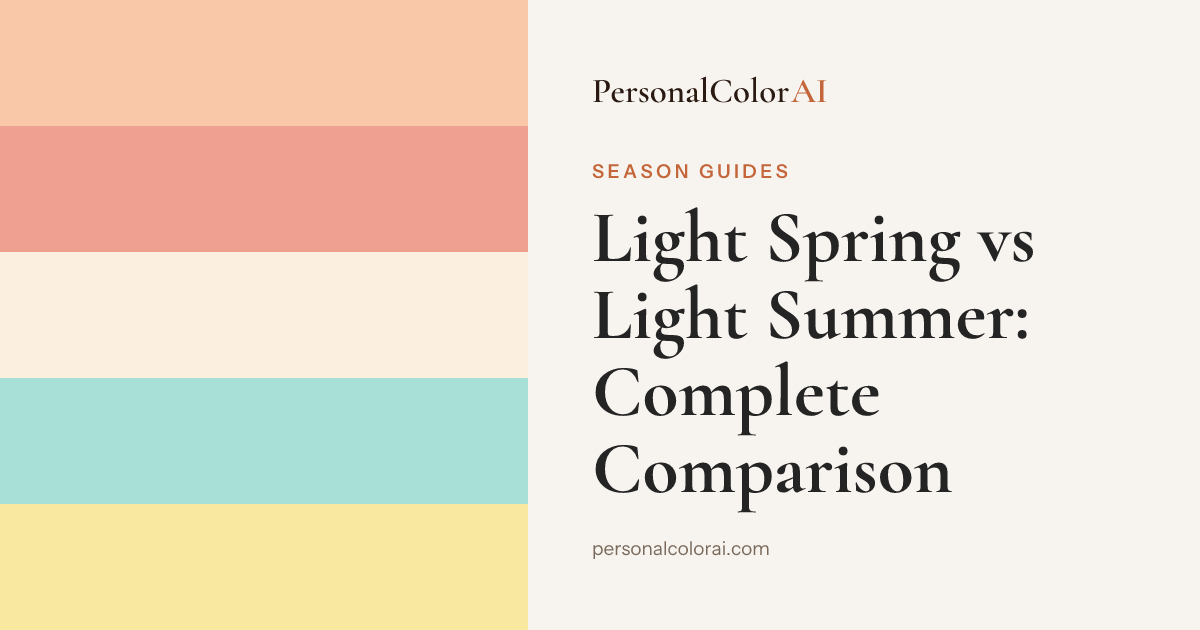
Light Spring and Light Summer share light depth and low contrast but differ on undertone — Light Spring is warm, Light Summer is cool. Light Spring runs on peach, coral, warm cream, and butter yellow; Light Summer runs on powder blue, soft rose, lavender, and periwinkle. Same lightness, opposite temperature. The tell: warm gold jewelry flatters Light Spring, silver flatters Light Summer, and both wash out in dark saturated colors.
Why is this the hardest pair to distinguish?
Light Spring and Light Summer are both extremely light, both low contrast, and both delicate. They are the two palest seasons in the system, and their overall visual impression is so similar that even experienced Korean color analysts stall on this boundary. If you are confused between them, you are not missing something obvious — this is genuinely the hardest pair to separate, because the only axis that differs is undertone. Light Spring is warm-neutral and Light Summer is cool-neutral, and everything else about the two — the low depth, the soft chroma, the gentle blended contrast — is nearly identical.
| Light Spring Palette | |||||
|---|---|---|---|---|---|
| #F8C8A8 | #F0A090 | #FBF0E0 | #A8E0D8 | #F8E8A0 | #F0C8B8 |
| Light Summer Palette | |||||
|---|---|---|---|---|---|
| #C0D8E8 | #F0C8D0 | #D0C8E8 | #B8E0D8 | #F0D8E0 | #C8D0D8 |
Light Spring vs Light Summer at a glance
| Trait | Light Spring | Light Summer |
|---|---|---|
| Undertone | Warm-neutral (golden) | Cool-neutral (rosy) |
| Value (depth) | Light | Light |
| Chroma (saturation) | Clear, slightly brighter | Soft, slightly muted |
| Contrast | Low | Low |
| Best metal | Warm gold | Silver or platinum |
| Best neutral | Warm ivory | Soft silver-gray |
| Signature colors | Peach, coral, warm cream, butter yellow | Powder blue, soft rose, lavender, dusty mint |
The 30-second decision tree
Work through these in order — the first clear yes settles it. First, does warm gold jewelry flatter you more than silver? If yes, lean Light Spring. Second, do your wrist veins read green rather than blue-purple? If yes, lean Light Spring. Third, does warm ivory suit you better than a cool soft-gray near your face? If yes, lean Light Spring. If silver, blue-purple veins, and cool gray win each time, you are Light Summer. If the answers split, you sit right on the Spring-Summer border, and either palette's lightest, most neutral colors will work — confirm with a free AI analysis.
The core difference — undertone only
Light Spring is warm-neutral. Light Summer is cool-neutral. Everything else — depth, contrast, delicacy, the soft low chroma — is nearly identical. This is the one pair in the whole system where undertone is the entire differentiator, which is exactly why the classic warmth cues carry so much weight here. When depth and contrast match this closely, the temperature of a color is the only thing left for your skin to react to, so gold-versus-silver and green-versus-blue veins become unusually decisive.
Three tests to tell them apart
The vein test and jewelry test are the most reliable for this pair. Gold versus silver, green veins versus blue-purple veins — these classic undertone indicators work particularly well precisely because depth and contrast are identical, so nothing else is competing for your eye. Then run the neutral test: hold warm ivory (#FBF0E0) against your face, then soft silver-gray (#C8D0D8). Whichever feels more like your neutral — the one that quietly disappears and lets your face take center stage — reveals your season. A neutral that fights you will cast a faint yellow or grey shadow at the jaw; the right one leaves your skin looking like itself.
Find your color season — free analysis
Who each season flatters
Light Spring flatters people with warm-neutral undertones, very light depth, and delicate low-contrast coloring — think Sydney Sweeney or Margot Robbie, who look fresh and luminous in soft peach, warm ivory, and light aqua. Light Summer flatters cool-neutral coloring with the same very light, delicate quality — Taylor Swift and Gwyneth Paltrow glow in powder blue, soft lavender, and rose gray. The full hex-coded wardrobes live on the Light Spring best colors and Light Summer best colors pages. Build the capsule the same way for both — a soft neutral base with pale accents — and let temperature do the sorting.
Common misreads to watch for
The mismatch here is the most subtle of any comparison, which is its own trap. A Light Spring in Light Summer's cool pastels looks slightly ashy or flat; a Light Summer in Light Spring's warm pastels looks slightly sallow. The effect is real but gentle, and it is consistently visible in photos even when it is hard to catch in a mirror, so trust the camera over your bathroom light. Two adjacent seasons cause most of the confusion. Soft Summer gets mixed in when a light, soft person cannot tell if they are warm or cool — but Soft Summer is muted, cool, and a touch deeper, so its greyed dusty rose and mauve read heavier than Light Spring's clear warm tints. True Spring gets mixed in from the other direction: it shares Light Spring's golden undertone but is deeper and more saturated, carrying coral and tomato red at full strength that would overwhelm the palest Spring. Every 'spring vs summer' question ultimately reduces to warm versus cool; get undertone right first and the rest of the 12-season map falls into place. If you are still stuck on the border, a photo analysis returns a confidence score plus your secondary season.
Frequently Asked Questions
What's the difference between Light Spring and Light Summer?
Both are very light and low contrast, making them the hardest season pair to distinguish. The only meaningful difference is undertone — Light Spring is warm-neutral (gold jewelry flatters, warm ivory is the best neutral) while Light Summer is cool-neutral (silver jewelry flatters, soft silver-gray is the best neutral).
How do I know if I'm Light Spring or Light Summer?
Use the jewelry test — hold gold then silver against your bare face in natural light. Also compare warm ivory fabric (#FBF0E0) to a cool soft gray-white (#C8D0D8). Whichever feels more harmonious with your complexion, leaving no yellow or grey shadow at the jaw, reveals your season.
Why do the vein and jewelry tests work so well for this pair?
Because depth, contrast, and chroma are nearly identical between Light Spring and Light Summer, temperature is the only variable left for your skin to react to. That makes classic undertone cues — green versus blue veins, gold versus silver — unusually decisive here compared with pairs that differ on several axes at once.
What if I test between Light Spring and Light Summer?
Landing on the border is common because these are the two palest seasons. When the tests split, wear the lightest, most neutral colors from either palette — soft warm-neutral tints that lean neither strongly gold nor strongly grey — and use a photo analysis with a confidence score to see which side you fall on.
Are Light Spring and Light Summer the rarest seasons?
Both are among the less common seasons because they require specific combinations — very light depth plus either a warm or cool undertone. Light Summer may be slightly less common than Light Spring, but neither is truly rare; they simply appear less often than the mid-depth seasons.