Deep Autumn vs. True Winter: Deep and Dramatic — But Very Different
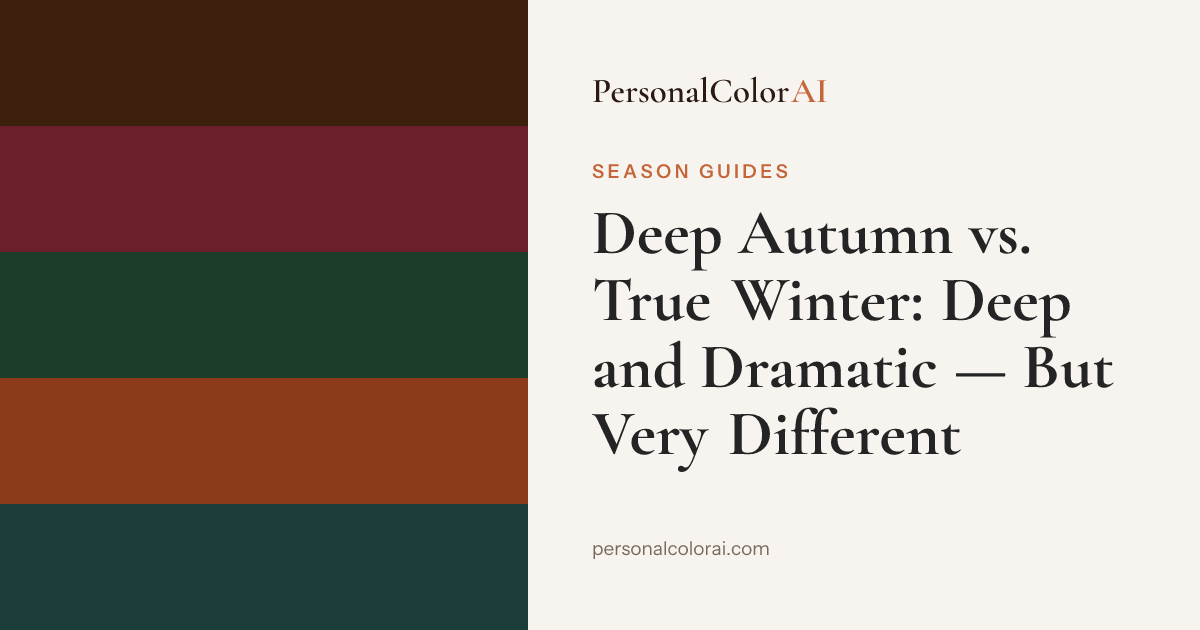
Deep Autumn and True Winter are both deep and high-contrast, but Deep Autumn is warm-neutral and True Winter is cool. The tell is neutrals: espresso and caramel ground Deep Autumn, while true black and stark white ground True Winter. Warm gold jewelry flatters Deep Autumn; silver and platinum flatter True Winter. Wearing the wrong undertone visibly drains the face, making this one of the most obvious mismatches in the system.
Both deep and dramatic — so how do you tell them apart?
Deep Autumn and True Winter share the two loudest signals in color analysis: deep value and high contrast. Both command a room, both look best in strong and decisive colors, and both make pastels look like they are apologizing. At a glance they feel like the same kind of coloring. But they sit on opposite sides of the warm-cool line, and unlike the muted seasons where a mismatch is subtle, here the mismatch is dramatic. Put a Deep Autumn in True Winter colors and the drain is visible from across the room. The depth and contrast are a shared frame; the undertone is what actually decides your season.
| Deep Autumn Palette | |||||
|---|---|---|---|---|---|
| #3D1F0D | #6B1F2A | #1C3D2A | #8B3A1A | #1A3D3A | #8B5E2A |
| True Winter Palette | |||||
|---|---|---|---|---|---|
| #1A1A1A | #F8F8F8 | #2040C0 | #1A8050 | #C02080 | #680828 |
The core difference: warm depth vs cool depth
Deep Autumn is warm-neutral. Its power neutrals are dark chocolate and caramel, and its accents — terracotta, burgundy, forest green, dark rust — all carry heat under the darkness. There is a golden or coppery thread even in its deepest shades. True Winter is decisively cool. Its power neutrals are true black and bright white, and its accents — royal blue, true red, emerald, ice pink, magenta — are clear and cold with no warmth allowed in. Both are deep, both are high-chroma enough to carry saturated color, and both thrive on contrast. The chroma and the drama are shared; only the temperature separates them, and temperature is exactly the axis the eye reads fastest on a face.
Three tests to settle it
The neutral test is the most definitive for this pair. Hold dark caramel or chocolate fabric to your face, then true black. One will look grounding and make your features look defined and healthy; the other will look faintly harsh or lifeless. Deep Autumn wins in warm dark neutrals, True Winter in cool stark ones. Second, the vein test: green-cast veins at the wrist lean Deep Autumn, blue-purple veins lean True Winter. Third, the jewelry test: warm gold echoes Deep Autumn's coloring while silver and platinum sharpen True Winter's. Because both seasons are deep, do not let depth fool you — a dark-haired, dark-eyed person can be either, and undertone is the only thing that actually splits them.
Find your color season — free analysis
Who each season flatters
Deep Autumn flatters people with warm-neutral undertones and rich, deep natural coloring — the ones for whom chocolate, burgundy, and forest green look like extensions of their own features rather than clothes layered on top. Zendaya and Jang Wonyoung read this way. True Winter flatters people with cool undertones and equally deep, high-contrast coloring — the ones who look sharpest in true black, bright white, and royal blue, like Kim Kardashian or Jisoo of BLACKPINK. The full hex-coded wardrobes live on the Deep Autumn best colors and True Winter best colors pages. Both build a capsule around a strong dark neutral — the difference is whether that neutral is warm espresso or cool jet black.
Common misreads and the bridge season
The classic misread here is watching what happens when each wears the other's colors. A Deep Autumn in True Winter's black-and-white will look washed out, the stark cool contrast draining the gold from warm skin. A True Winter in Deep Autumn's caramel and chocolate will look muddied, the warmth casting a sallow film over cool clarity. If you genuinely test evenly between the two, the answer is usually Deep Winter — it carries the extreme depth of both with a cool-neutral undertone that bridges the gap and can borrow from either palette. Skin depth alone never decides this; someone with very deep skin can be either season. If you are stuck, a free AI analysis reads undertone, depth, and contrast from one selfie and returns a confidence score plus your secondary season.
Frequently Asked Questions
What's the difference between Deep Autumn and True Winter?
Both are deep and high-contrast, but Deep Autumn is warm-neutral while True Winter is cool. Deep Autumn's best neutrals are dark chocolate and warm caramel; True Winter's are true black and bright white. Wearing the wrong season's neutrals creates an immediately visible disharmony that leaves the skin looking washed out or muddied.
How do I tell if I'm Deep Autumn or True Winter?
Run the neutral test: hold dark chocolate fabric to your face, then true black. Whichever makes your features look grounded and healthy points to your season. Back it up with the vein test (green leans Deep Autumn, blue-purple leans True Winter) and jewelry (gold for Deep Autumn, silver for True Winter).
Can you be between Deep Autumn and True Winter?
Deep Winter sits directly between them — it has the depth of Deep Autumn with a cool-neutral undertone closer to True Winter. If you test genuinely evenly between the two, Deep Winter is likely your actual season, since it can borrow elements from both palettes.
Which season suits darker skin tones — Deep Autumn or True Winter?
Both appear across all skin depths. The determining factor is undertone, not surface skin color. Deep Autumn suits warm-neutral undertones; True Winter suits cool undertones. A person with deep skin can be either season depending on their undertone.
Why does the wrong palette look so dramatic on this pair?
Because both seasons are already high-contrast and saturated, an undertone mismatch has nothing muted to soften it. Warm gold-based colors on cool True Winter skin, or cold blue-based colors on warm Deep Autumn skin, produce a full-strength clash — one of the most obvious mismatches in the twelve-season system.