Bright Spring vs. Bright Winter: Both Vivid, Opposite Undertones
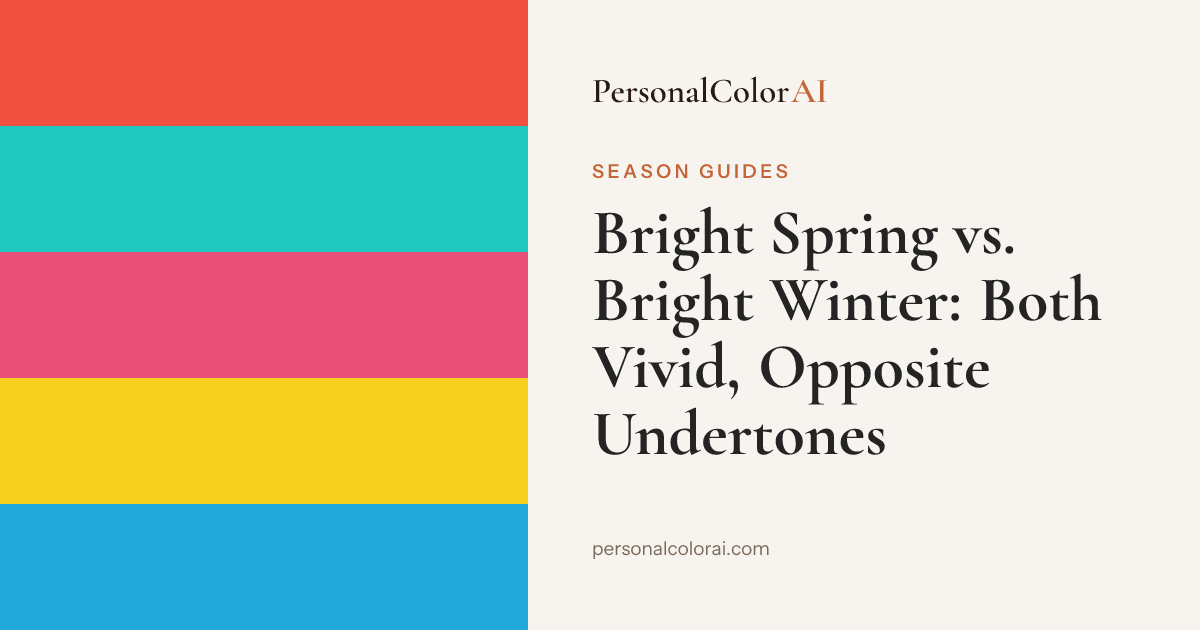
Bright Spring and Bright Winter are both high-contrast and vivid, but Bright Spring is warm while Bright Winter is cool. Bright Spring glows in hot coral, bright turquoise, warm fuchsia, and clear yellow. Bright Winter shines in electric blue, hot pink, vivid purple, icy mint, and pure red. The fastest tell: warm gold flatters Bright Spring, while silver and platinum flatter Bright Winter. Neither suits muted earth tones.
What's the difference between Bright Spring and Bright Winter?
These are the two most saturated seasons in the system, so their overall impact is nearly identical: punchy, electric, impossible to ignore. Both demand full-strength color and both reject anything dusty or greyed. The only thing that separates them is the direction of the undertone. Bright Spring is warm — its brights are lit from behind with gold, so hot coral, clear yellow, and warm fuchsia radiate against golden skin. Bright Winter is cool — its brights are lit with ice, so electric blue, magenta, and vivid purple snap against cool skin. Same voltage, opposite polarity. If you want each palette in full, the Bright Spring color guide and the Bright Winter color guide lay out the complete spectrum.
| Bright Spring Palette | |||||
|---|---|---|---|---|---|
| #F05040 | #20C8C0 | #E8507A | #F8D020 | #20A8D8 | #F07830 |
| Bright Winter Palette | |||||
|---|---|---|---|---|---|
| #F8F8F8 | #1060F0 | #E01880 | #8020C0 | #A0F0E0 | #E02020 |
The deciding cue: which vivid feels harmonious
Because both seasons are equally bright and equally high-contrast, chroma and contrast can't separate them — you go straight to temperature. The cleanest single test is hot coral (#F07830) versus electric blue (#1060F0). Hold each against bare skin in daylight. One makes your face look lit and alive; the other stays bold on the fabric but feels slightly disconnected from your skin, still loud but not in harmony. Because both seasons carry so much natural contrast, this difference tends to be more obvious than it is for softer pairs — the mismatch practically jumps out. The jewelry test backs it up: gold for Bright Spring, silver or platinum for Bright Winter.
Which one am I? The orange test
There is one shortcut that settles this pair faster than anything else: orange. Bright orange is a purely warm color that cool seasons cannot carry. If bright orange makes you look vibrant and healthy, you are Bright Spring — only warm seasons hold orange without a fight. If orange turns your skin muddy, sallow, or grey, you are Bright Winter, because cool undertones reject it decisively. Run the mirror image to confirm: electric blue makes a Bright Winter glow and makes a Bright Spring look faintly cold and washed. When both the orange test and the blue test point the same way, you have your answer. When you want a second opinion from something that isn't your own eye, a free AI analysis reads undertone and contrast from a single selfie.
For the full palettes behind this comparison, see the Bright Spring color palette and the Bright Winter color palette, each with hex codes, best and worst colors, makeup, and hair.
Find your color season — free analysis
What each season flatters, and common misreads
Bright Spring flatters warm brights — hot coral, clear yellow, warm fuchsia, bright turquoise — with warm ivory and light camel as neutrals. Tzuyu of TWICE and Ariana Grande read as textbook warm-vivid coloring. Bright Winter flatters cool brights — electric blue, magenta, vivid purple, icy mint — with black and stark white as neutrals. Lisa of BLACKPINK and Lupita Nyong'o show the cool-electric version. The most common misread is confusing either bright season with its True or Deep neighbor: someone who is genuinely Bright can dial their color down too far because full saturation feels 'loud,' then wonders why muted tones leave them looking tired. The tell is that brights energize a Bright season rather than overwhelming them. The other frequent slip is calling a Bright Winter a Bright Spring after a summer tan darkens the skin — depth changed, undertone did not.
What happens when you wear the wrong season
A Bright Spring in Bright Winter's electric blue and vivid purple looks cold: the vibrancy is right but the temperature fights the skin. A Bright Winter in Bright Spring's hot coral and warm yellow looks muddied: the warmth clashes with cool features and dulls the natural clarity. Both seasons want maximum vibrancy — just in opposite temperatures. Get the temperature right and the brightness that overwhelms other people becomes your best asset.
Find your season
Not sure whether your brights should run warm or cool? Upload a selfie and our free AI analysis places you in one of the twelve seasons in about a minute, then hands you the palette to shop from.
Frequently Asked Questions
What's the difference between Bright Spring and Bright Winter?
Both are high-contrast and vivid, but Bright Spring is warm-undertoned while Bright Winter is cool-undertoned. Bright Spring suits warm brights like hot coral, clear yellow, and warm fuchsia. Bright Winter suits cool brights like electric blue, magenta, and vivid purple. Undertone is the only real separator.
How do I know if I'm Bright Spring or Bright Winter?
Use the orange test. If bright orange makes you look vibrant, you're Bright Spring — only warm seasons carry orange. If orange makes your skin look muddy or sallow, you're Bright Winter. Confirm with electric blue, which makes Bright Winter glow and makes Bright Spring look slightly cold.
What traits do Bright Spring and Bright Winter share?
They're the two most saturated, highest-contrast seasons in the system. Both look best in clear, full-strength color and both look tired or dulled in muted earth tones and dusty pastels. That shared vividness and contrast is exactly why they get confused despite opposite undertones.
Can you be between Bright Spring and Bright Winter?
Because they have opposite undertones, sitting exactly between them is less common than sitting between adjacent seasons. If standard undertone tests genuinely won't resolve, the orange versus electric blue comparison is the most reliable single separator for this pair.
Which is more common — Bright Spring or Bright Winter?
Both are relatively uncommon because each needs high contrast plus a specific undertone. Bright Winter may be slightly more common given the global prevalence of cool-undertoned, high-contrast coloring, but neither is a frequent result.