Soft Summer vs Soft Autumn: How to Tell the Difference
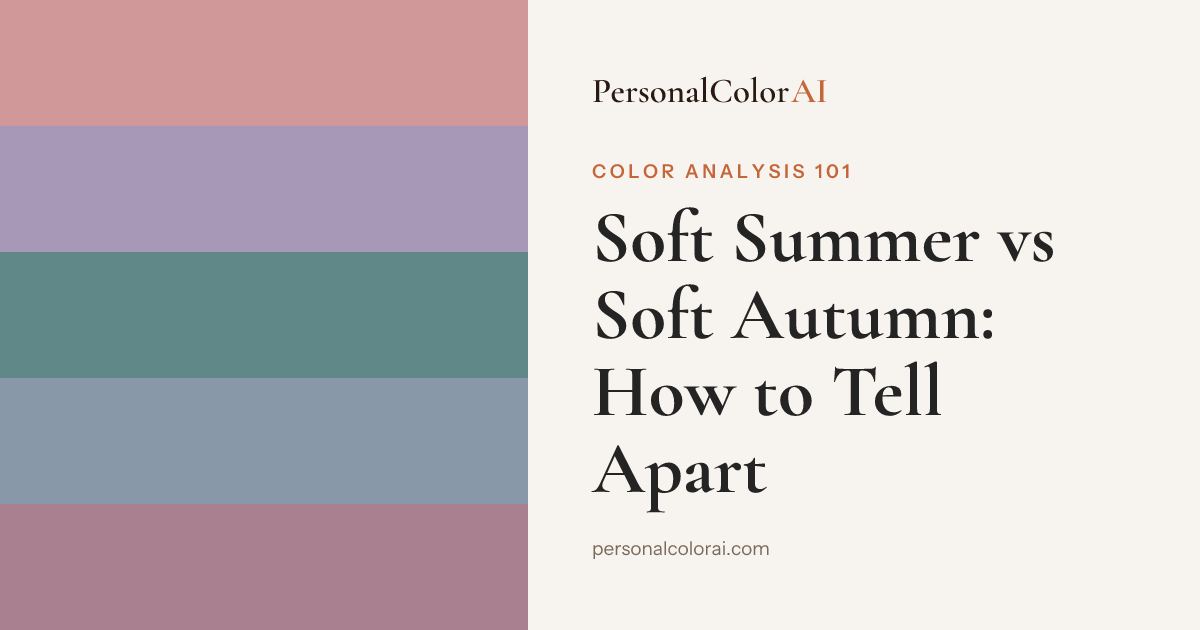
Soft Summer and Soft Autumn both have muted coloring with low contrast, but Soft Summer is cool-neutral and Soft Autumn is warm-neutral. Soft Summer wears dusty rose, sage, soft plum, cool gray, muted blue. Soft Autumn wears dusty peach, sage, warm taupe, muted olive, soft camel. Both share sage and dusty pinks — the swing factor is whether warm or cool jewelry tones flatter you. Brushed silver vs brushed gold is the most reliable test.
If you've taken a color analysis quiz and landed somewhere between Soft Summer vs Soft Autumn, you're not alone. These two seasons are the most commonly confused pair in the entire 12-season system. Both are low-chroma, medium-depth seasons that look best in dusty, toned-down colors rather than anything bright or saturated. The difference comes down to one thing: temperature.
A sizable share of people who get professionally typed fall into one of the muted seasons, and Soft Summer versus Soft Autumn is one of the most common mix-ups among them. The two seasons share the same low chroma and low contrast, so the only real difference is a subtle lean in undertone, which is easy to misread on a first try.
How common are the two? In our 1,705-analysis study, Soft Autumn (15.4%) and Soft Summer (15.1%) were the second and third most common results, behind only Deep Autumn (28.3%). Together they made up 30.5% of all results, so nearly a third of the people our analyzer read landed in one of these two muted seasons. Those shares describe how the tool classified real phone selfies, not a population census.
Find your color season — free analysis
What's the difference between Soft Summer and Soft Autumn?
Both seasons share low chroma (muted, dusty colors) and medium depth (not very light, not very dark). What separates them is undertone. Soft Summer has a cool undertone — a blue-grey or pink-grey base to the skin. Soft Autumn has a warm undertone — a golden-grey or olive-grey base. Everything else follows from that split. Soft Summer's best neutrals are cool greys and slate. Soft Autumn's best neutrals are warm taupes and khaki. Same mutedness, opposite temperature.
Side-by-Side Comparison
| Soft Summer | Soft Autumn | |
|---|---|---|
| Undertone | Cool (blue-pink base) | Warm (golden-olive base) |
| Value/Depth | Medium to medium-light | Medium to medium-deep |
| Chroma | Low — muted and dusty | Low — muted and earthy |
| Best Metals | Silver, white gold, rose gold | Gold, brass, bronze, copper |
| Best Neutrals | Slate grey, mauve, soft navy | Taupe, khaki, warm brown |
| Best Accent Colors | Dusty rose, sage green, lavender, soft teal | Terracotta, olive, burnt sienna, mustard |
| Worst Colors | Bright orange, electric blue, neon anything | Fuchsia, icy blue, stark black-and-white |
| Celebrity Examples | Dakota Johnson, Jessica Alba, Emily Blunt | Elizabeth Olsen, Drew Barrymore, Gisele Bündchen |
How to Tell Which One You Are
Three quick tests that work without a professional draping session:
The jewelry test. Hold a piece of silver jewelry against your inner wrist, then swap it for gold. Soft Summers almost always look better in silver — the cool metal harmonizes with their blue-pink undertone. Soft Autumns look warmer and more alive in gold. If both look roughly equal, you're likely on the border between the two, and your veins and lip color will be the tiebreaker.
The fabric drape test. Find two scarves or t-shirts: one in dusty rose (a cool muted pink) and one in warm terracotta (an earthy orange-brown). Hold each under your chin in natural daylight. Soft Summers will notice the dusty rose makes their skin look even and smooth, while terracotta adds a yellowish or muddy cast. Soft Autumns get the opposite result — terracotta makes them glow, while dusty rose makes them look slightly grey or washed out.
The lip color test. Look at your bare lips in natural light. Soft Summers tend toward a mauve or cool pink natural lip color. Soft Autumns tend toward a peachy, warm-nude, or brownish-pink natural lip color. Natural lip color is one of the more useful at-home clues for separating the muted seasons, and often a clearer one than vein color, which can be misleading on medium skin tones.
Soft Summer in Detail
Soft Summer sits where cool meets muted. You have a blue-pink base to your skin, medium-light to medium depth, and low contrast between your features. Your hair is typically medium ash brown, dark blonde, or mousy brown — rarely jet black or platinum. Your eyes tend toward grey-blue, grey-green, hazel, or soft brown.
Your best colors all share a dusty, greyed-out quality with a cool lean. Dusty rose, sage green, soft teal, lavender, slate blue, and mauve are your power shades — the heart of the Soft Summer palette. For neutrals, reach for cool grey, soft navy, and greige (grey-beige). Avoid anything neon, highly saturated, or warm-based — bright orange, electric yellow, and warm red will overpower your natural softness.
In makeup, Soft Summers do well with cool-toned mauves, dusty pinks, and soft berry shades. At Korean beauty retailers, muted cool-toned lip shades reliably outsell bright ones among customers who self-identify as Summer seasons — proof that these toned-down cool colors resonate with a large audience.
Soft Autumn in Detail
Soft Autumn sits where warm meets muted. You have a golden or olive base to your skin, medium depth, and low-to-medium contrast. Your hair is typically warm brown, golden brown, dark strawberry blonde, or chestnut. Your eyes lean toward hazel, warm green, topaz brown, or amber.
Your best colors are earthy and toned-down with a warm lean. Terracotta, olive green, burnt sienna, warm camel, mustard (not bright yellow — muted mustard), and warm sage are where you thrive, as the Soft Autumn palette lays out. For neutrals, think taupe, khaki, chocolate brown, and warm ivory. Avoid anything icy, stark, or cool-saturated — fuchsia, cobalt blue, and high-contrast black-and-white pairings will make you look tired.
For makeup, Soft Autumns gravitate toward warm nudes, peachy browns, and terracotta lip shades. Bronzer tends to work better than pink blush. In K-beauty, rom&nd's Juicy Lasting Tint Autumn Series is an easy place to see this range, with nutty, browned shades like Nudy Peanut and Eat Dotori built for warm, muted coloring.
What If You're In Between?
Here's the thing people don't talk about enough: the 12-season system has hard borders, but human coloring doesn't. If you're sitting right on the Soft Summer / Soft Autumn line, you probably have a neutral undertone that leans very slightly warm or very slightly cool. People with genuinely neutral undertones are the ones most likely to land on this border, and for them the jewelry and drape tests above matter more than any single feature.
If that's you, the good news is that both soft palettes will work reasonably well. Lean toward the season that matches your dominant undertone in most lighting conditions — not just one specific test. And borrow from the other palette when it suits the occasion. A Soft Summer who looks great in one particular warm taupe isn't broken. It just means you're near the boundary.
The most accurate way to settle the question is with an AI color analysis that uses your actual photo. A camera captures the full range of your skin's undertone and surface color at once, which is why photo-based analysis often catches nuances that a single draping test misses. You can also try the color quiz if you'd prefer a questionnaire-based approach.
Find your color season — free analysis
Frequently Asked Questions
What is the difference between Soft Summer and Soft Autumn?
Both are muted, low-chroma seasons with medium depth. The difference is undertone: Soft Summer has a cool (blue-pink) base, while Soft Autumn has a warm (golden-olive) base. This means Soft Summer looks best in cool dusty shades like lavender and sage, while Soft Autumn looks best in warm earthy shades like terracotta and olive.
Can you be both Soft Summer and Soft Autumn?
Not technically — the 12-season system assigns one season. But if you have a neutral undertone, you may sit right on the border and look good in colors from both palettes. About 15-20% of people have genuinely neutral undertones that make this boundary blurry. Focus on whichever palette flatters you in most lighting conditions.
What is the best metal for Soft Summer?
Silver and white gold are the best metals for Soft Summer because they match the cool undertone. Rose gold also works well since it's a muted, soft metal. Yellow gold can look slightly off against Soft Summer's blue-pink skin base.
What colors should Soft Autumn avoid?
Soft Autumn should avoid cool, bright, and high-contrast colors. Fuchsia, icy blue, cobalt, stark black-and-white pairings, and neon shades will clash with the warm, muted quality of Soft Autumn coloring. Pastels that are too cool or washed-out can also make Soft Autumns look tired.
How do I know if I'm a Soft Summer or a True Summer?
Soft Summer is more muted and slightly warmer than True Summer. True Summer has a clearer, more obviously cool complexion and can handle slightly brighter cool tones like medium blue and rose pink. Soft Summer needs those colors toned down — greyed-out and dusty. If bright cool colors overpower you, you're likely Soft rather than True Summer.